Oh, the humble dandelion. Dandelions are so under-appreciated in our age of pristine grass lawns! I'll save the lawn rant for another day - for now, let's appreciate the glory of this well-known 'weed'.
Dandelions are edible and medicinal, and easy (so easy!) to find. Their uses range from wine to salads to medicinal tonics, and they are perfect to harvest this time of year.
Dandelions are edible and medicinal, and easy (so easy!) to find. Their uses range from wine to salads to medicinal tonics, and they are perfect to harvest this time of year.
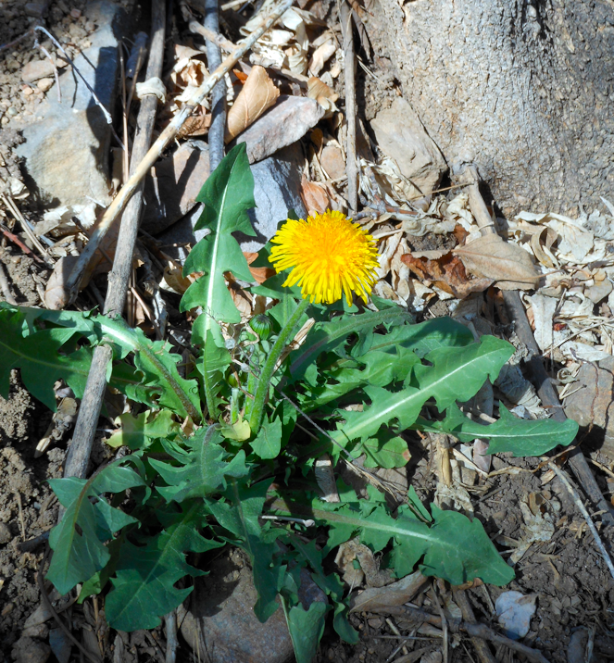
One of spring's first blooms, down by our creek bed.
Spotlight on Dandelion
Common dandelion (Taraxacum officinale), gets its name from the French 'dent-de-lion' or 'lion's tooth', and is related to chicory and wild lettuce. Dandelion leaves, flowers, and root are all edible, and are also useful to make herbal remedies, especially tonics for liver and your overall health.
Is it native?
Dandelions were introduced to North America from Europe, and have spread so rapidly they grow nearly world-wide. Though not on the official Colorado list of noxious weeds, dandelions are often considered an 'extremely invasive, alien species'. Sounds kind of sci-fi! Who knew dandelions were so menacing?
How do I identify it?
Let's face it - we all know what a dandelion looks like. Plus, there are no poisonous look-alikes to confuse us! But just in case:
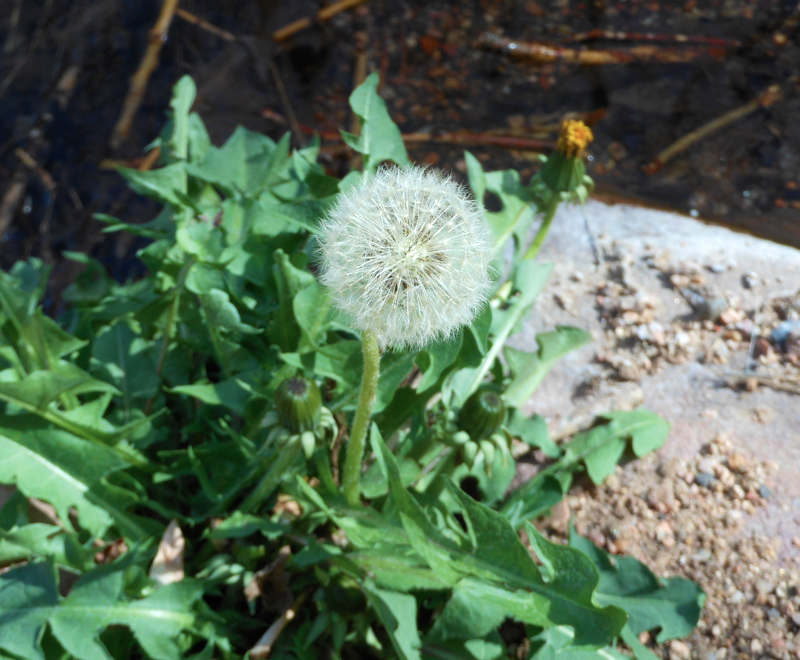
Dandelions have yellow, composite flowers that reach 1-2 inches across. The flowers are made up of hundreds of tiny petals, and grow individually on hollow flowerstalks. When dandelions reach maturity, they transform into a white, spherical seedhead - each seed has a tiny 'parachute' that lets it float on the wind.
Dandelion leaves are 3-12 inches long, and 1/2 to 2 1/2 inches wide, always growing in a basal rosette (clustered on the ground). The leaves are lance-shaped and deeply toothed, with a distinct 'mid-rib' running their length.
Dandelions have a thick, brittle, beige taproot that can grow up to 10 inches long. When broken, both the root and the flowerstalk ooze a white, milky sap. (Dandelion roots are so difficult to remove that my landscaping friends and I nicknamed them 'spiteweed'. Turns out, the more you try to weed them up, the more pieces break off in the ground, and the faster the dandelions grow back. Good for foragers, at least!)
Where can I find it?
Everywhere! Okay, not really - but nearly. Dandelions love 'disturbed habitats', such as lawns and sunny, open stretches of earth. Their habitat covers every state and province in North America, and a great deal of Europe and Asia. Dandelions are so adaptive that their habitat may well be more widespread - if you know, leave a comment!
A better question is: When can I find it?
Dandelions grow year-round, but the greens are best harvested in early spring and late fall, when they have the least bitterness. Flowers are best harvested mid-spring, just after they bloom (make sure to only use the yellow parts - the green sepals are quite bitter). The taproot is tastiest when you harvest it late fall to early spring.
What can I use it for?
Oh, I'm so glad you asked! Lots of things. Let's break it down, shall we?
Dandelions were introduced to North America from Europe, and have spread so rapidly they grow nearly world-wide. Though not on the official Colorado list of noxious weeds, dandelions are often considered an 'extremely invasive, alien species'. Sounds kind of sci-fi! Who knew dandelions were so menacing?
How do I identify it?
Let's face it - we all know what a dandelion looks like. Plus, there are no poisonous look-alikes to confuse us! But just in case:
Dandelions have yellow, composite flowers that reach 1-2 inches across. The flowers are made up of hundreds of tiny petals, and grow individually on hollow flowerstalks. When dandelions reach maturity, they transform into a white, spherical seedhead - each seed has a tiny 'parachute' that lets it float on the wind.
Dandelion leaves are 3-12 inches long, and 1/2 to 2 1/2 inches wide, always growing in a basal rosette (clustered on the ground). The leaves are lance-shaped and deeply toothed, with a distinct 'mid-rib' running their length.
Dandelions have a thick, brittle, beige taproot that can grow up to 10 inches long. When broken, both the root and the flowerstalk ooze a white, milky sap. (Dandelion roots are so difficult to remove that my landscaping friends and I nicknamed them 'spiteweed'. Turns out, the more you try to weed them up, the more pieces break off in the ground, and the faster the dandelions grow back. Good for foragers, at least!)
Where can I find it?
Everywhere! Okay, not really - but nearly. Dandelions love 'disturbed habitats', such as lawns and sunny, open stretches of earth. Their habitat covers every state and province in North America, and a great deal of Europe and Asia. Dandelions are so adaptive that their habitat may well be more widespread - if you know, leave a comment!
A better question is: When can I find it?
Dandelions grow year-round, but the greens are best harvested in early spring and late fall, when they have the least bitterness. Flowers are best harvested mid-spring, just after they bloom (make sure to only use the yellow parts - the green sepals are quite bitter). The taproot is tastiest when you harvest it late fall to early spring.
What can I use it for?
Oh, I'm so glad you asked! Lots of things. Let's break it down, shall we?
| Leaves 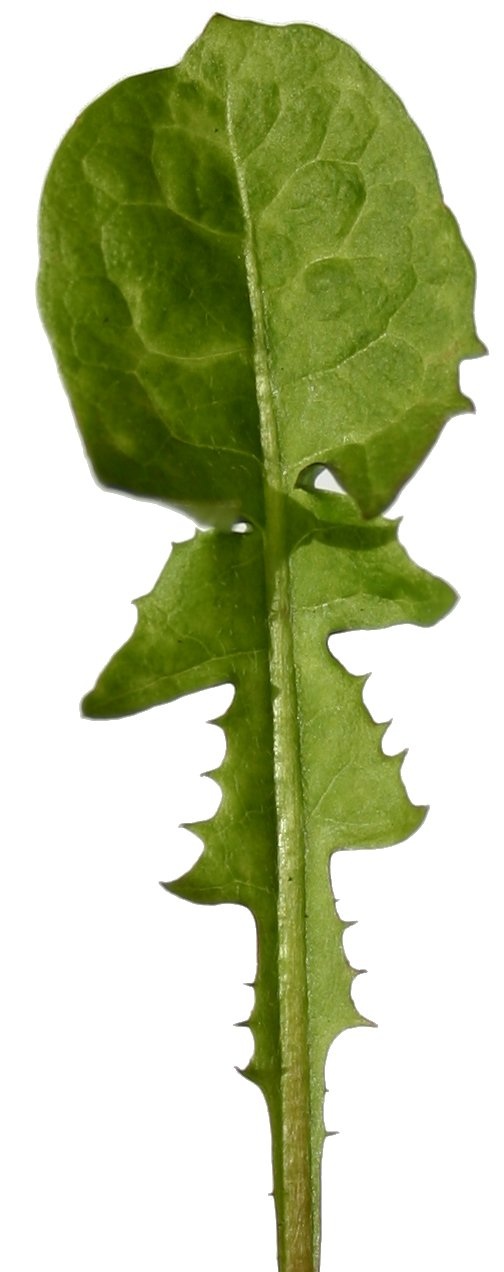 | Edible ~ Salads - taste like chicory and endive, slightly bitter (use young, non-flowering leaves for less bitterness) ~ Sauté or steam (~ 20 min., especially with garlic and olive oil, or with sweet vegetables like carrots) ~ Boil in one or more changes of water (lessens bitterness) | Medicinal ~ Dandelion leaf infusions (teas) encourage digestion by stimulating stomach acid and digestive enzymes, and act as a diuretic, improving kidney function. ~ Leaves' milky sap removes warts, moles, pimples, calluses, and sores, and soothes bee stings and blisters ~ When eaten, extremely high nutritional value (see 'Vitamins & Minerals' below) |
| Flowers  | Edible ~ Salads: adds color, texture, and bittersweetness ~ Sauté in oil ~ Batter and fry into fritters ~ Steam with other vegetables ~ Pickle in vinegar ~ Brew in tea ~ Ferment: dandelion wine! | Medicinal ~ Antioxidant properties ~ When eaten, high in nutritional value ~ As a wine, very high in potassium |
| Roots  | Edible ~ Cook as a vegetable, especially in soups (pre-boiling with changes of water lessens bitterness) ~ Sauté in olive oil (good with tamari soy sauce and onions) ~ Dried and roasted, as a coffee-like beverage | Medicinal ~ Decoction (like tea, but boiled longer) is a traditional tonic to strengthen whole body, especially the liver and gallbladder. - Good for chronic hepatitis: reduces liver swelling and jaundice, and indigestion caused by insufficient bile. - Promotes bile flow, reduces inflammation, and helps clear gallstones. - Acts as gentle diuretic, improving kidney function without leaching potassium. * Don't use with irritable stomach or bowel, or acute inflammation |
Vitamins & Minerals
Dandelion leaves are higher in beta carotene than carrots, and higher in iron and calcium than spinach. They also contain vitamins B1, B2, B5, B6, B12, C, E, P, and D, as well as biotin, inositol, potassium, phosphorus, magnesium, and zinc.
Scientific Evidence
Dandelion root contains the sugar inulin, which doesn't cause rapid production of insulin the way refined sugars do, and helps mature-onset diabetes and hypoglycemia. The root also contains taraxacin, which promotes bile flow and reduces bile duct inflammation.
"The plant has an antibacterial action, inhibiting the growth of Staphylococcus aureus, Pneumococci, Meningococci, Bacillus dysenteriae, B. typhi, C. diphtheriae, Proteus etc."
How do I prepare it?
Wildcrafting/Foraging
Harvest only 1 plant per every 4 present, in order to preserve aesthetic and ecological integrity. Harvest only from locations where pesticides/herbicides have not been applied. Refer to 'When do I find it?' section for ideal harvesting times.
Leaves and flowers are easily picked by hand - roots require a deep trowel and patience!
You can dry dandelion plants in the sun, spread in a single layer, or on low in a dehydrator.
Infusion/tea
~ 1 c. boiling water
~ 1-2 tsp. dried & crushed dandelion leaves / flowers
Pour boiling water over dandelion parts, cover, and let steep for 5-10 minutes. Add honey if desired, or brew with lemon, orange peel, or mint. Drink up to 3 times daily.
Decoction/root tea
~ 1-2 tsp. chopped dandelion root (dried or fresh)
~ 1 1/2 pints boiling water
Place root in pot of boiling water, and let simmer until amount of water has reduced by about a third (~15 minutes). Strain and store in a cool place. Re-heat and add honey if desired. Drink up to 3 wine-glass-sized servings a day.
Dandelion leaves are higher in beta carotene than carrots, and higher in iron and calcium than spinach. They also contain vitamins B1, B2, B5, B6, B12, C, E, P, and D, as well as biotin, inositol, potassium, phosphorus, magnesium, and zinc.
Scientific Evidence
Dandelion root contains the sugar inulin, which doesn't cause rapid production of insulin the way refined sugars do, and helps mature-onset diabetes and hypoglycemia. The root also contains taraxacin, which promotes bile flow and reduces bile duct inflammation.
"The plant has an antibacterial action, inhibiting the growth of Staphylococcus aureus, Pneumococci, Meningococci, Bacillus dysenteriae, B. typhi, C. diphtheriae, Proteus etc."
How do I prepare it?
Wildcrafting/Foraging
Harvest only 1 plant per every 4 present, in order to preserve aesthetic and ecological integrity. Harvest only from locations where pesticides/herbicides have not been applied. Refer to 'When do I find it?' section for ideal harvesting times.
Leaves and flowers are easily picked by hand - roots require a deep trowel and patience!
You can dry dandelion plants in the sun, spread in a single layer, or on low in a dehydrator.
Infusion/tea
~ 1 c. boiling water
~ 1-2 tsp. dried & crushed dandelion leaves / flowers
Pour boiling water over dandelion parts, cover, and let steep for 5-10 minutes. Add honey if desired, or brew with lemon, orange peel, or mint. Drink up to 3 times daily.
Decoction/root tea
~ 1-2 tsp. chopped dandelion root (dried or fresh)
~ 1 1/2 pints boiling water
Place root in pot of boiling water, and let simmer until amount of water has reduced by about a third (~15 minutes). Strain and store in a cool place. Re-heat and add honey if desired. Drink up to 3 wine-glass-sized servings a day.
Thanks to Steve Brill's Identifying and Harvesting Edible and Medicinal Plants!
What experience do you have with dandelion? Any other uses? Please link up to your favorite dandelion recipes!
You might like:
- Wild Forage: Mullein
- Herbal Sleep Aid Tea
- Find Balance in Nature and the Elements
- Mental Health: Taking Care of the Basics
What experience do you have with dandelion? Any other uses? Please link up to your favorite dandelion recipes!
You might like:
- Wild Forage: Mullein
- Herbal Sleep Aid Tea
- Find Balance in Nature and the Elements
- Mental Health: Taking Care of the Basics
This post shared at:
Mind Body and Sole, White Wolf Summit Farmgirl, GNOWFGLINS, Nourishing Gourmet, Live Renewed, Real Food Freaks, Food Renegade, Nifty Thrifty Things, Petite Hermine, Natural Mothers Network, Butter Believer, Ask Anna, Healthy Home Economist, Prairie Homestead, Real Food Forager, Cooking Traditional Foods, Little Farm in the Big City, Frugally Sustainable, Kelly the Kitchen Kop, and Real Food Whole Health!
Mind Body and Sole, White Wolf Summit Farmgirl, GNOWFGLINS, Nourishing Gourmet, Live Renewed, Real Food Freaks, Food Renegade, Nifty Thrifty Things, Petite Hermine, Natural Mothers Network, Butter Believer, Ask Anna, Healthy Home Economist, Prairie Homestead, Real Food Forager, Cooking Traditional Foods, Little Farm in the Big City, Frugally Sustainable, Kelly the Kitchen Kop, and Real Food Whole Health!



